 susan@shin-yua.com
 My inquiry
 My Account
 Upload BOM
AI in Semiconductor Manufacturing: From Yield Optimization to Autonomous Fabs
AI in semiconductor manufacturing is fundamentally changing how chips are designed, fabricated, and optimized. Once just a product enabled by silicon, artificial intelligence is now becoming an essential tool for making it. As transistors shrink to atomic scales and wafer fabrication processes involve hundreds of complex steps, traditional rule-based process control is hitting fundamental limits.
Manufacturers face soaring costs, unpredictable equipment downtime, and yield rates that crawl to improve. This is where AI in semiconductor manufacturing is stepping in to drive a fundamental shift-from reactive, human-driven decisions to predictive, data-driven automation.
In this article, we will explore the real-world use cases of AI in semiconductor fabs, quantify its benefits, address the adoption challenges, and look at what the future holds for AI-driven chip manufacturing.
How AI Is Used in Semiconductor Manufacturing
To understand the impact, we first need to see how AI fits into the overall manufacturing ecosystem. AI is not a single tool but an overarching capability applied across the entire fab workflow.
Unlike traditional methods that rely on fixed rules and statistical process control (SPC), AI models learn directly from historical production data. They identify complex, non-linear patterns that human engineers might miss. AI in semiconductor manufacturing covers everything from wafer fabrication and defect detection to supply chain logistics. It acts as a layer of intelligence above existing automation, enabling machines to not just execute but also predict, adapt, and optimize in real-time.
Key Use Cases of AI in Semiconductor Fabs
This is where AI delivers tangible value. Below are the five most impactful use cases currently deployed in leading fabs worldwide.
AI for Yield Optimization
Yield-the percentage of functional chips on a single wafer-is the single most important metric in semiconductor manufacturing. A 1% drop in yield can mean millions in lost revenue.
AI for yield optimization analyzes vast datasets from every step of the fabrication process. Machine learning models correlate equipment parameters, material properties, and environmental factors to predict yield loss before it occurs. By identifying critical variables that impact yield, AI enables engineers to fine-tune processes proactively. The result is faster yield ramps for new nodes and higher stable yields for mature nodes.
AI for Defect Detection
Inspection is traditionally a bottleneck. Human review of optical inspection images is slow, subjective, and impossible for advanced nodes where defects are measured in nanometers.
AI-powered defect detection uses deep learning and computer vision to automatically classify defects with higher accuracy and speed. These models are trained on thousands of labeled defect images. Once deployed, they instantly identify defect types, severity, and even suggest probable root causes. This reduces the time for inspection from hours to minutes, frees up engineers for higher-level analysis, and ensures that only quality wafers proceed to the next stage.
AI for Predictive Maintenance
Semiconductor fabrication equipment-like EUV lithography scanners and etch chambers-costs tens of millions of dollars. Unplanned downtime can cost a fab over $100,000 per hour.
AI for predictive maintenance uses IoT sensors and machine learning to monitor equipment health in real-time. The models learn the normal vibration, temperature, and pressure patterns. When anomalies appear-indicating a pending failure-the system triggers an alert. This allows maintenance teams to intervene during scheduled downtime, replace parts before they break, and extend equipment lifespan.
Leading semiconductor manufacturers such as Intel and TSMC have adopted AI-driven predictive maintenance to reduce unplanned downtime, with industry studies reporting reductions of up to 40–60%.
AI in Wafer Fabrication Process
The wafer fabrication process involves hundreds of steps: lithography, etching, deposition, and chemical mechanical planarization (CMP). Each step requires microscopic precision.
AI in wafer fabrication enables real-time process control. By reading sensor data mid-process, AI models can adjust parameters on the fly. For example, in plasma etching, AI can predict the final etch depth and adjust the duration to compensate for chamber drift. In CMP, AI models predict the optimal downforce and slurry flow to achieve uniform film thickness. This level of dynamic adjustment is impossible with static recipes.
AI for Supply Chain Optimization
A modern fab relies on a global network of suppliers for raw silicon wafers, specialty gases, photoresists, and spare parts. A shortage of any single component can halt production
AI for semiconductor supply chain optimization analyzes market trends, order backlogs, and internal production schedules to predict demand for critical materials. It can identify potential shortages weeks in advance and suggest alternative suppliers or inventory buffers. Post-pandemic, this has become a strategic priority, with AI helping manufacturers build resilience against geopolitical and logistical disruptions.
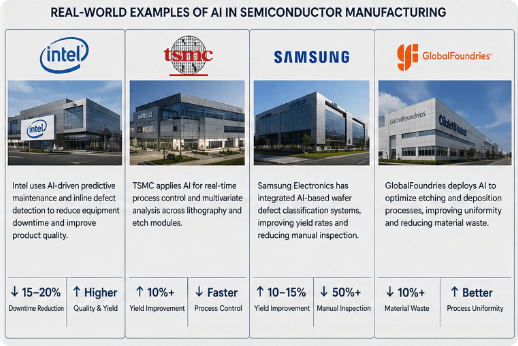
Real-World Examples of AI in Semiconductor Manufacturing
AI is not a future concept-it is already deployed across leading fabs today:
- Intel Corporation uses AI-driven predictive maintenance and inline defect detection to reduce downtime and improve quality.
- TSMC applies AI for real-time process control and multivariate analysis across lithography and etch modules.
- Samsung Electronics has integrated AI-based wafer defect classification systems to improve yield and reduce manual inspection efforts.
These real-world implementations demonstrate that AI in semiconductor manufacturing is delivering measurable ROI today.
Benefits of AI in Semiconductor Manufacturing
The benefits of AI in semiconductor manufacturing are already measurable and being realized by early adopters. Below are the five primary benefits:
- Higher Yield: By optimizing process parameters and detecting subtle defect patterns, AI helps fabs achieve yield improvements of 5% to 15% for new nodes.
- Lower Cost: Reduced waste of expensive raw materials (silicon, gases, chemicals) and better equipment utilization directly lower the cost per good die.
- Faster Production: AI reduces cycle times by automating inspections and enabling faster root cause analysis, speeding up time-to-market for new chips.
- Better Quality Control: AI-based defect detection provides consistent, objective inspection results, eliminating human fatigue and variability.
- Reduced Downtime: Predictive maintenance minimizes unplanned stops, keeping critical tools running at maximum availability.
AI adoption in semiconductor manufacturing is expected to grow rapidly, driven by investments in advanced automation and analytics platforms.
AI vs Traditional Process Control in Semiconductor Manufacturing
To fully appreciate AI's impact, it helps to contrast it with traditional semiconductor process optimization. Traditional methods rely on fixed rules and react to problems after they occur. They are linear, assuming variables act independently, and static-capturing knowledge in rules that never learn from new data.
In contrast, AI-driven semiconductor optimization is fundamentally different. It is predictive, identifying issues before they cause defects. It is non-linear, capturing complex interactions between hundreds of process parameters. And most importantly, it is adaptive-continuously learning and improving as new production data arrives.
Traditional Process Control AI-Driven Optimization
Reactive (fix after failure) Predictive (prevent before failure)
Linear (single variable) Non-linear (hundreds of variables)
Static rules Adaptive learning
Human-dependent Data-automated
In short, traditional optimization tells you that something is out of spec. AI tells you why it will go out of spec and how to prevent it.
Challenges of AI Adoption in Semiconductor Industry
Despite the promise, implementing AI in semiconductor manufacturing is not trivial. Manufacturers face several real challenges:
- Data Quality and Quantity: AI models need large volumes of clean, labeled data. In a fab, data is often noisy, incomplete, or siloed across different tools. Annotating defect images for supervised learning is expensive and time-consuming.
- Integration with Legacy Systems: Most fabs run on established Manufacturing Execution Systems (MES) that were not designed to interface with streaming AI analytics. Overhauling or integrating with these systems can be complex and costly.
- High Implementation Cost: Developing, training, and deploying custom AI models requires a team of data scientists, machine learning engineers, and domain experts. The upfront investment in infrastructure (edge servers, data lakes, GPUs) is significant.
- Explainability and Trust: Engineers are trained to trust physics and known rules. A deep learning model is often a "black box." If a model flags a defect but cannot explain why, engineers are reluctant to act, especially in high-stakes decisions.
Future of AI in Semiconductor Manufacturing
Looking ahead, the role of AI in semiconductor manufacturing will only expand. The convergence of AI with other advanced technologies will reshape the industry further:
- Autonomous Fabs: The ultimate goal is "lights-out" manufacturing-fully automated fabs where AI manages scheduling, process control, maintenance, and logistics with minimal human intervention.
- AI and EUV for Advanced Nodes: As we move to sub-2nm nodes, extreme ultraviolet (EUV) lithography becomes even more complex. AI will play a critical role in real-time dose control and mask optimization.
- AI-Driven R&D: Generative AI will be used to discover new materials (e.g., for interconnects or dielectrics) and to simulate entire fabrication processes, drastically reducing the need for expensive experimental runs.
- AI and Digital Twins: A complete digital twin of a fab-a virtual replica that mirrors the physical one-powered by AI, will allow engineers to test changes and run "what-if" scenarios without any risk to real production.
According to industry analyses from firms such as McKinsey & Company and Boston Consulting Group, AI-driven fabs could reduce operating costs by up to 30% while significantly accelerating yield ramp times over the next decade.
Conclusion
AI in semiconductor manufacturing has moved from a competitive advantage to a strategic necessity. From improving yield and detecting nanoscale defects to predicting equipment failures and optimizing supply chains, AI is addressing the industry's most stubborn challenges.
While issues like data quality, integration costs, and model explainability remain, the benefits-lower cost, faster production, and higher quality-are too compelling to ignore. The transition may not be easy, but the future is clear: every leading-edge fab will be an AI-driven fab.
As we look toward autonomous fabs and AI-enabled digital twins, one thing is certain-the hardware that runs the world's AI will increasingly be made by AI itself.
AI in semiconductor manufacturing is no longer optional-it is becoming the foundation of modern chip production.
Frequently Asked Questions About AI in Semiconductor Manufacturing
What is AI in semiconductor manufacturing?
AI in semiconductor manufacturing refers to the use of machine learning, computer vision, and predictive analytics to optimize wafer fabrication processes. It is used for yield optimization, defect detection, predictive maintenance, and real-time process control to reduce costs and improve efficiency.
How does AI improve yield in semiconductor fabs?
AI improves yield by analyzing massive amounts of historical and real-time data from the production line. It detects subtle patterns and correlations that lead to defects or performance loss. By predicting these issues early, engineers can adjust processes to prevent low-yield outcomes.
What are examples of AI in chip manufacturing?
Examples include TSMC using AI for real-time process control, Samsung Electronics integrating AI for wafer defect classification, GlobalFoundries deploying AI to optimize etching and deposition, and Intel Corporation using AI-driven predictive maintenance to reduce downtime.
What companies are using AI in semiconductor manufacturing?
Leading semiconductor manufacturers using AI include TSMC, Intel Corporation, Samsung Electronics, and GlobalFoundries. TSMC uses AI for real-time process control, Intel deploys AI for predictive maintenance and defect detection, and Samsung has integrated AI to improve yield rates by reducing manual inspection efforts.
Is AI necessary for modern semiconductor manufacturing?
Yes. As process complexity increases at advanced nodes (3nm and below), AI is becoming essential for maintaining yield, reducing costs, and ensuring process stability. Leading fabs are already integrating AI into core operations, and those that do not risk falling behind in competitiveness.
What is the future of AI in semiconductor fabs?
The future of AI in semiconductor fabs is moving toward autonomous factories (lights-out manufacturing), AI integrated with EUV lithography for sub-2nm nodes, generative AI–driven materials discovery, and digital twin simulations. These developments will reduce human intervention and accelerate innovation cycles.
What are the challenges of using AI in semiconductor industry?
The main challenges include ensuring high-quality and consistent training data, integrating AI with legacy factory systems, high upfront costs for infrastructure and talent, and a lack of model explainability that makes engineers hesitant to trust AI decisions.
Related Information

- Help you to save your cost and time.

- Reliable package for your goods.

- Fast reliable delivery to save time.

- Quality premium after-sale service.


