 susan@shin-yua.com
 My inquiry
 My Account
 Upload BOM
Relay in Electronic Circuits: Types, Working Principle, and Real-World Applications Guide
I've worked with relays for years, and if there's one component that quietly holds entire systems together, it's this one. A relay is never just a switch to me-it's a boundary. A way to let a fragile control signal command something far more powerful without ever touching it.
What is a relay and how does it actually work in a circuit
When I look at a relay inside a circuit, I don't just see a component-I see a relationship between control and load. At its core, a relay converts a small electrical input into a switching action. In an electromechanical relay, that transformation is physical: a coil energizes, a magnetic field forms, and an armature moves. That movement is what ultimately decides whether current flows somewhere else.
What matters in real designs is not just that it switches, but how it switches. Whether the contact is normally open or normally closed isn't just a definition-it determines system behavior during failure, startup, and idle states. I've seen entire systems behave incorrectly simply because that default state wasn't thought through.
Electromechanical relay vs solid state relay in practical applications
I don't treat electromechanical relays and solid-state relays as interchangeable-they solve different problems.
When I need robustness and clear physical isolation, I still trust electromechanical relays. They handle high current loads well, and when they fail, they tend to fail in ways that are easier to diagnose. You can hear them, measure them, even see contact degradation over time.
But when speed or switching frequency becomes critical, I move to solid-state relays. No mechanical delay, no contact bounce, no wear. In high-frequency control systems or precision electronics, that difference is not theoretical-it directly affects stability.
Still, SSRs bring their own trade-offs. Heat is always there, quietly building up. If you ignore thermal design, the relay won't fail immediately-it will degrade, and that's often worse.
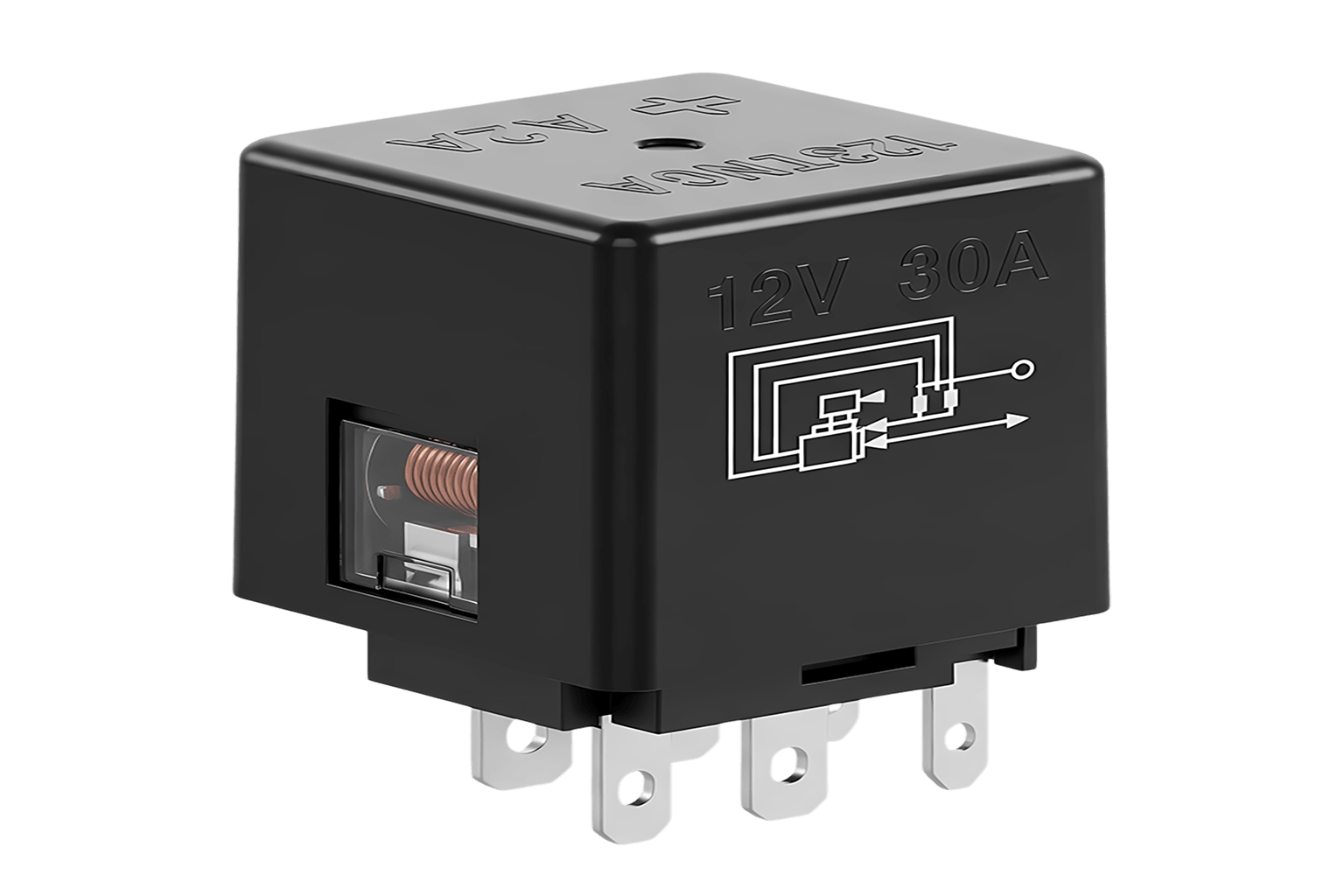
Key relay parameters I always evaluate before choosing one
Over time, I've stopped thinking in terms of "relay types" and started thinking in terms of attributes.
The first thing I look at is load-voltage and current are non-negotiable. Then I look at switching behavior: how fast it needs to respond, and how often it will switch. A relay that works perfectly at low frequency can become a liability in a high-cycle system.
Contact material is something many overlook, but it directly affects lifespan. Silver alloys, for example, perform well under load but behave differently depending on the environment. In humid or corrosive conditions, small material choices turn into big reliability issues.
And then there's isolation. In mixed-signal systems, especially where control logic meets power electronics, that separation is not just useful-it's essential.
How relays are really used in industrial, automotive, and appliance systems
In industrial control panels, I've used relays as the bridge between logic and machinery. A PLC sends a signal, but it's the relay that actually drives a motor, opens a valve, or shuts down a system when something goes wrong. That layer of separation protects both sides.
In automotive systems, the role is different. Space is tighter, environments are harsher, and reliability expectations are higher. Relays quietly manage headlights, wipers, and ignition-related functions, often switching under conditions that are far from ideal.
In household appliances, the relay disappears into the background. You don't hear about it when your refrigerator works-but it's there, controlling compressors and heaters, cycling thousands of times over its life.
How I approach relay selection in real engineering scenarios
I never start by asking "which relay is best." I start by asking what the system demands.
If the environment involves vibration, I immediately question mechanical reliability. If switching frequency is high, I lean toward solid-state. If cost is tight and loads are heavy, electromechanical often wins.
Temperature, humidity, electrical noise-these aren't edge cases. They are the reality of deployment. A relay that works perfectly on paper can fail quickly in the field if these factors are ignored.
What I've learned is this: selecting a relay is less about the component itself and more about understanding the system it lives in.
Where relay technology is heading from an engineer's perspective
Relays aren't going away, but they are changing.
I see electromechanical designs getting more refined-better materials, longer life, less bounce. At the same time, solid-state relays are pushing into areas they couldn't reach before, especially as power handling and thermal design improve.
What's interesting is not that one replaces the other, but that the boundary between them is shifting. The choice is becoming less obvious-and more dependent on how well you understand the trade-offs.
From where I stand, relays remain one of those components that reward experience. On the surface, they're simple. In real systems, they're anything but.
Related Information

- Help you to save your cost and time.

- Reliable package for your goods.

- Fast reliable delivery to save time.

- Quality premium after-sale service.


