 susan@shin-yua.com
 My inquiry
 My Account
 Upload BOM
ICM-42688-P IMU: Low Noise Performance & Drone Control Insights
The ICM-42688-P is widely used in modern motion sensing systems, but its value is often misunderstood if evaluated only by headline specifications.
In practice, IMU selection is rarely about choosing the sensor with the lowest noise or highest sampling rate in isolation. Instead, the deciding factor is how the sensor behaves within a real system-under vibration, across temperature changes, and inside a control loop.
This article examines the ICM-42688-P from that perspective, combining verified specifications with practical engineering considerations.
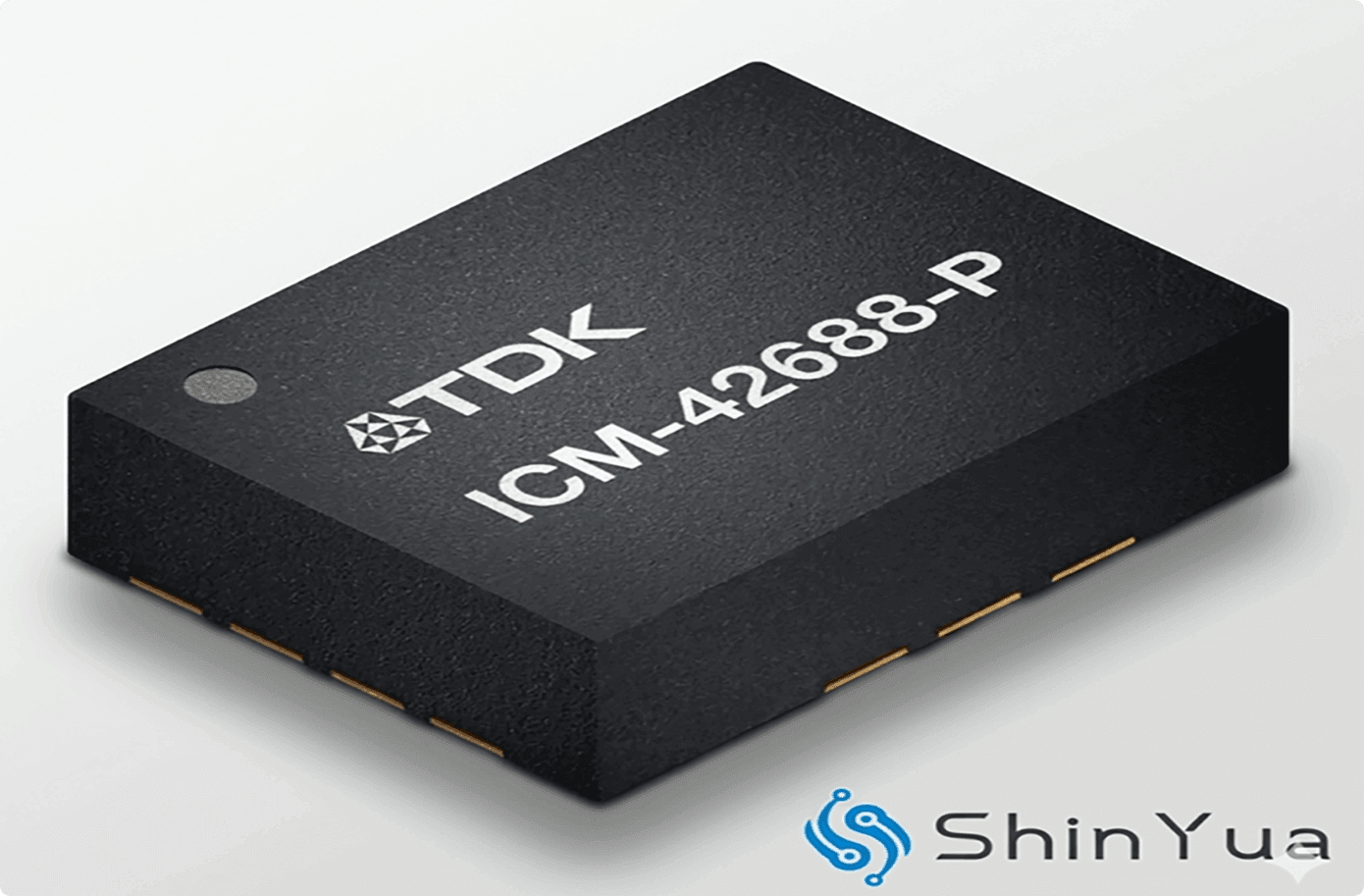
Device Overview and Verified Specifications
The ICM-42688-P is a 6-axis inertial measurement unit developed by TDK InvenSense, integrating a 3-axis gyroscope and a 3-axis accelerometer.
According to the official datasheet published by TDK , key parameters include:
- Gyroscope noise density: approximately 0.0028 dps/√Hz
- Accelerometer noise density: approximately 70 µg/√Hz
- Maximum output data rate: up to 32 kHz
- Digital interfaces: I3C, I2C, and SPI
These values establish a baseline for evaluating performance, but they do not directly predict system-level behavior.
Where Performance Differences Actually Matter
In controlled conditions, many IMUs appear similar. Differences become visible when the sensor operates within a dynamic system.
In drone flight controllers, for example, motor and propeller vibration typically introduce disturbances in the 100–300 Hz range. If the sensor bandwidth overlaps with this region, the resulting signal may contain periodic noise components that are difficult to filter without introducing delay.
Older devices such as MPU-6050 often require aggressive low-pass filtering to suppress this noise. While effective, such filtering increases latency, which degrades control loop responsiveness.
The ICM-42688-P reduces this trade-off. Its lower noise floor and improved vibration rejection allow engineers to use less aggressive filtering, preserving both signal quality and response time.
This difference is not easily observed in static testing, but becomes significant in closed-loop control systems.
Interaction with Sensor Fusion Algorithms
The quality of IMU data directly affects the performance of sensor fusion algorithms such as complementary filters and Kalman filters.
Higher noise levels increase uncertainty in state estimation, forcing the algorithm to rely more heavily on filtering and smoothing. This slows convergence and can introduce lag in dynamic motion.
With lower noise input, as provided by the ICM-42688-P, the estimator can respond more quickly to real changes in motion. This leads to more stable orientation tracking and reduced tuning effort.
However, it is important to note that sensor quality alone does not guarantee performance. Poor parameter tuning or incorrect noise modeling can still lead to suboptimal results.
Practical Limits: What the Datasheet Does Not Tell You
Datasheet values are measured under controlled conditions and do not account for system-level effects.
In real designs, several factors can dominate IMU performance:
- Mechanical coupling between the sensor and vibration sources
- PCB layout and proximity to switching components
- Power supply noise coupling into analog front-end circuits
- Temperature-induced bias drift
For example, even a low-noise IMU can exhibit degraded performance if mounted on a rigid PCB directly connected to high-vibration structures. In such cases, mechanical isolation often provides more improvement than changing the sensor itself.
This highlights a key point: sensor selection and system design must be considered together.
Technical Comparison with Legacy IMUs
Legacy devices such as MPU-6050 remain widely used due to cost and availability, but they impose constraints on system design.
Higher noise density requires stronger filtering, and lower sampling rates limit responsiveness. These factors increase the complexity of control algorithms and tuning processes.
Devices like ICM-20602 improve certain aspects but still show limitations under vibration-heavy conditions.
The ICM-42688-P addresses these issues by combining lower noise with higher data rates and improved internal filtering. The result is not just better specifications, but a more manageable system integration process.
For reference, historical product information can be found via TDK product archive .
Case Study: Improving Stability in a Drone Flight Controller
To better understand the practical impact of IMU selection, consider a typical drone flight control scenario.
In an early prototype using MPU-6050, the system exhibited noticeable oscillation during mid-throttle operation. This condition corresponded to a vibration band roughly between 120 Hz and 250 Hz, caused by motor imbalance and frame resonance.
To stabilize the system, a low-pass filter with a relatively low cutoff frequency was applied. While this reduced noise, it also introduced latency into the control loop. The result was slower response to rapid attitude changes and reduced flight precision.
After replacing the IMU with the ICM-42688-P, two changes were observed.
First, the baseline noise level in the gyro signal decreased, which allowed the cutoff frequency of the filter to be increased without reintroducing instability. Second, the vibration-induced oscillation was less pronounced, reducing the need for aggressive filtering altogether.
With these adjustments, the control loop was able to operate with lower latency. In practice, this resulted in faster stabilization after disturbances and improved responsiveness during rapid maneuvers.
It is important to note that the improvement was not solely due to the sensor replacement. Minor adjustments to mounting and filtering were still required. However, the ICM-42688-P reduced the extent of compensation needed, making the system easier to tune and more stable overall.
This type of improvement is often not visible in datasheet comparisons, but becomes clear during system-level testing and tuning.
Design Considerations for Reliable Performance
Achieving consistent performance with the ICM-42688-P depends on several design factors.
1. Mechanical Placement
The sensor should be placed away from vibration sources where possible. If this is not feasible, damping materials or soft mounting techniques can reduce vibration transmission.
2. Power Integrity
Noise on the supply line can couple into the sensor's internal circuits. Proper decoupling and filtering are necessary to maintain signal quality.
3. Thermal Behavior
Bias drift across temperature changes can accumulate over time. Systems requiring long-term stability should implement calibration or compensation strategies.
4. Interface Timing and Configuration
Improper configuration of sampling rates or communication timing (I2C/SPI/I3C) can introduce data inconsistencies or missed samples. Ensuring correct register configuration and synchronization is essential.
Further background on these topics is available in IEEE Xplore which provides research on IMU noise modeling and calibration techniques.
Supply, Traceability, and Risk Control
For production use, sourcing reliability is as important as technical performance.
The ICM-42688-P remains in active production as of 2025–2026, but availability can vary depending on market demand.
A robust sourcing process should include:
- Verification of date code and lot traceability
- Inspection of packaging and labeling consistency
- Sample-based functional testing when required
For projects with long production cycles, consistency between batches is critical. Variations in sourcing can introduce subtle differences that affect system calibration and performance.
Final Evaluation of ICM-42688-P for Real-World Applications
The ICM-42688-P is not simply an incremental upgrade over earlier IMUs. Its main advantage lies in how it reduces the gap between theoretical performance and real-world behavior.
Lower noise and improved vibration handling allow simpler filtering strategies and more responsive control systems. However, these benefits can only be realized when combined with proper system design, including mechanical layout, power integrity, and calibration.
For engineers, the value of this sensor lies in how it simplifies system behavior under real conditions. For procurement teams, ensuring traceability and supply consistency remains essential for maintaining long-term reliability.
Understanding both aspects is key to successfully deploying the ICM-42688-P in modern motion sensing applications.
Related Information

- Help you to save your cost and time.

- Reliable package for your goods.

- Fast reliable delivery to save time.

- Quality premium after-sale service.


