 susan@shin-yua.com
 My inquiry
 My Account
 Upload BOM
LM358 Substitution: Direct Replacement & Upgrade Paths for Engineers and Procurement
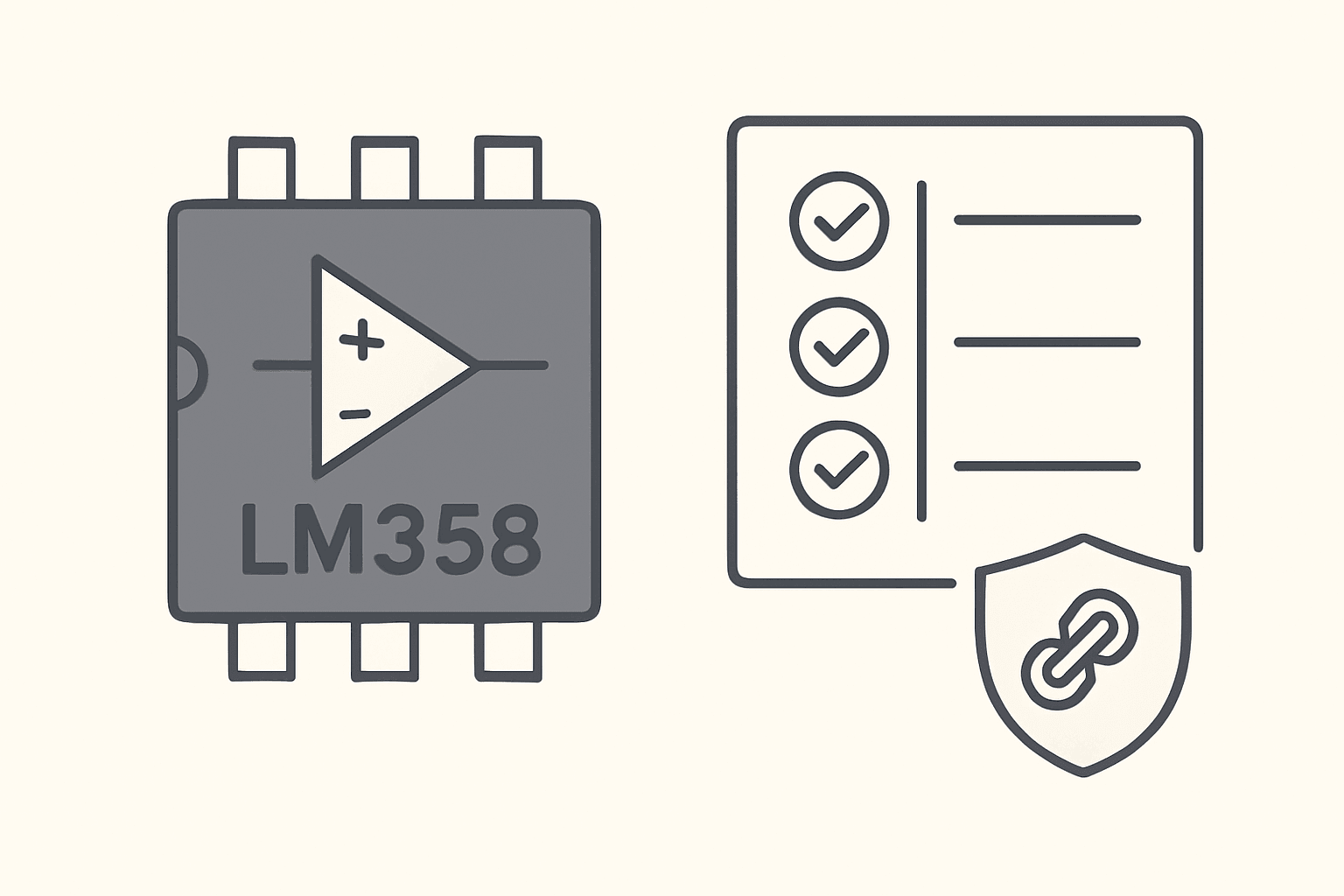
The LM358 is one of those "evergreen" operational amplifiers commonly used in industrial applications. When facing issues like component shortages, fluctuating lead times, or cost optimization, finding a substitute becomes a frequent task for both engineering and procurement teams.
The problem, however, is that many substitution lists simply suggest "similar models," but they don't clarify the electrical boundaries that could cause issues. Even more crucially, they often ignore aspects like material validation, documentation chains, batch consistency, and counterfeit prevention.
This article provides a practical approach with two substitution paths:
- Direct Replacement (Pin-to-Pin): Keeping changes to the board minimal, with risk controlled within the validation range.
- Upgrade Substitution (Allowing board modifications): Using RRIO, lower offset, lower power, or higher speed to improve the system's stability and operational range.
Warning: As soon as the "input common-mode range" is violated, operational amplifiers with architectures like the LM324/LM358 may exhibit unpredictable output states. TI's design guidelines clearly state that if both inputs exceed the upper common-mode range, the output could fall to either high or low, and the result will vary with batch, temperature, or process. This means the behavior is "undefined," not just a "slight distortion" (TI guideline forum reference).
Why LM358 is a High-Frequency Substitute Component
From a supply chain perspective, the issue with the LM358 is not whether it's available, but rather:
- Fluctuating lead times and price volatility.
- Multiple similar models across different manufacturers and versions (different temperature grades, process generations).
- Many circuits use it as a "universal op-amp" capable of operating up to 30V, but in reality, it is not rail-to-rail, and its upper-end margin, load capability, and stability need to be carefully considered.
From an engineering perspective, LM358 is commonly used in:
- Sensor conditioning
- Low-frequency amplification
- Comparators/shapers (non-high-speed)
- Current sensing
- Simple active filtering and more.
Because it's so widely used, substitution typically happens during the mass production phase, and any potential issue-no matter how small-can be amplified.
Understand the Key Boundaries of the LM358 (Which Determine Direct Substitution Feasibility)
The following dimensions will determine whether a "similar-looking" op-amp can serve as a direct replacement for the LM358.
Supply Voltage Range: 3.3V/5V or 12V/24V?
One of the key selling points of LM358 is its wide supply range. For example, the LM358 can support a single supply voltage of 3–30V (it can also be used with dual supplies). However, the replacement question is:
- Do you need a supply voltage greater than 6V?
- Does the replacement work well at 3.3V, with the appropriate input/output range?
Many upgrade substitutes like RRIO CMOS op-amps only support 1.8–5.5V or 1.8–6V, offering better performance but are not suitable for high-voltage applications.
Input Common-Mode Range: Ground ≠ Positive Supply
The LM358, being a classic bipolar op-amp, has the following common features:
- Input common-mode includes ground (negative supply).
- The upper-end common-mode range typically requires some margin from V+ (there may be slight variations across manufacturers and versions).
When substituting, if your sensor or voltage divider signals are near the positive supply, you must verify:
- The upper common-mode limit, especially across temperature ranges.
- Whether exceeding this limit might trigger output phase reversal or undefined behavior (refer to the warning section earlier).
Output Swing & Load: Low-End Can Reach Ground, High-End May Not Reach V+
Many circuits seem to have no issue with the output because the output swing does not approach the positive supply. The LM358's output high level typically has noticeable margin from V+, which depends on load current and load resistance.
When substituting, two common pitfalls are:
- Need for output to be close to V+ (e.g., for upper limit detection, full-scale output).
- Driving heavy loads (e.g., low-resistance loads, long lines, capacitive loads).
Speed Characteristics: GBW / Slew Rate Determines "Waveform Tracking"
The LM358's typical GBW and slew rate are in the "low-speed" category. When substituting, you should ask:
- Are you performing active filtering, PWM sampling, or requiring faster transitions?
- Have you increased gain or bandwidth in the closed loop?
Using faster op-amps may result in oscillation (due to PCB, compensation networks, or load phase shifts), which can be harder to stabilize.
Direct Substitution Path: Pin-to-Pin (How to Screen Candidates, Using LM358DR/SOIC-8 as an Example)
When searching for a "pin-to-pin" replacement for LM358, you're likely asking if it's possible to simply swap the part number without modifying the board.
For a valid pin-to-pin replacement, the following conditions must be met:
- Same package and pinout (SOIC-8 / same pinout).
- Supply voltage range must cover the original design (including transients and tolerances).
- Input common-mode/output swing must not create "undefined zones."
- Key stability conditions should remain at least as good.
Grouping Direct Substitutes (More Practical than Just a List of Part Numbers)
To make the screening process faster, group potential substitutes by:
- Same series/same positioning: LM358/LM2904 family from multiple sources.
Advantage: Most similar to "direct replacement," and procurement can easily manage multiple sources.
Risk: Variations in bias current, offset, ESD/EMI, and temperature range across manufacturers or versions (e.g., B versions). Critical details like input common-mode and output swing should be cross-checked.
- Low-voltage versions (e.g., "LMV358") typically support 2.7–5.5V systems and have better output swing.
Risk: If your original design uses 12V/24V single supply, low-voltage versions are not direct substitutes.
- True RRIO CMOS op-amps (mostly for upgraded replacements) often provide better experience in 3.3V/5V systems.
Risk: These may have lower supply voltage limits than the LM358 and different characteristics in input protection, ESD, output drive capability, noise, and stability.
Engineering "Direct Substitution Red Flags" Checklist
Before moving to sample validation, use the following checklist:
- Supply voltage range (including absolute maximum and recommended operating range) should cover your original design.
- Input common-mode range should cover your actual input voltage profile (especially near V+).
- Output swing meets full-scale requirements under load conditions (especially high-end margin).
- Unity-gain stability (or phase margin) under your actual closed-loop gain.
- Input offset and drift won't affect system accuracy (especially for sensor conditioning).
- Input bias current and impedance won't affect the front-end stage (important for high-impedance sources or large resistor networks).
- Output drive capability (source/sink current) meets load and dynamic requirements.
- Temperature grade, reliability, and compliance requirements (industrial/automotive/medical).
Upgrade Path: Choosing RRIO, Low Offset, Low Power, Faster Speed (When Board Modifications Are Allowed)
The goal of upgrade substitution is to push your system beyond the limits of LM358, not just match the part number.
Here are four common upgrade routes (choose based on need):
Need Closer Full-Scale: Prioritize RRIO
When your system operates at 3.3V/5V and you need the input/output to be closer to the supply rails, RRIO is often a better choice than LM358.
- Example: Microchip's MCP6002 (1.8–6V RRIO), which is ideal for low-voltage systems.
Be aware: These devices are typically not suitable for direct replacement in 12V/24V single-supply systems.
Need Higher Precision: Low Offset/Low Drift ("Zero Drift")
If LM358 is used in sampling/measurement applications, offset and drift directly translate to system errors. Upgrade strategy:
- Choose low-offset, low-drift op-amps.
- Verify input bias current and ensure it doesn't introduce errors with the source impedance.
Need Faster Dynamics: Higher GBW / Higher Slew Rate
If LM358 "can't keep up" or you need higher closed-loop bandwidth, upgrading to an op-amp with higher GBW and slew rate is a natural choice.
However, faster doesn't always mean more stable.
- Faster op-amps may require additional compensation (e.g., series resistors, RC networks) and can be sensitive to PCB layout and load capacitance.
Need Lower Power: Prioritize Battery or Standby Current
LM358 is not optimized for ultra-low-power applications. For battery-powered or standby-sensitive systems, the upgrade path should focus on:
- Quiescent current
- Shutdown features (if available)
- Low-voltage operation
Engineering Validation Checklist: From Samples to Small-Scale Production
Whether you're directly substituting or upgrading, split validation into three layers:
- Functional Validation (quickly eliminate issues):
- Does the DC operating point match expectations?
- Does it exhibit saturation, phase reversal, or undefined behavior in critical input ranges?
- Does the output swing meet full-scale requirements?
- Stability & Boundary Validation (often overlooked):
- Load changes (resistive/capacitive).
- Temperature points (at least room temp, plus high and low temperature).
- Power supply fluctuations and transients.
- System-Level Validation (focused on mass production concerns):
- Error budget (offset, drift, noise).
- EMI/ESD sensitivity.
- Interaction with upstream and downstream stages (ADC sampling, filtering networks, protection circuits).
Procurement Risk Control Checklist: Documentation, Traceability, Batch Consistency, and Counterfeit Prevention
If the introduction of alternative materials relies solely on engineering confirmation that "it works," the most common issues that arise later include:
- Parameter drift caused by changes in batch or source
- Incomplete documentation chains leading to roadblocks during customer audits
- Significantly increased risk of gray-market products or counterfeits during stockouts
We recommend that the procurement team implement at least six measures (i.e., upgrading the "LM358 alternative models" from a simple table into an auditable process):
- Clearly define acceptable manufacturers and versions (including temperature grade, package type, and tape-and-reel)
For example, specify "SOIC-8 + tape-and-reel + industrial/automotive grade" as auditable terms
- Include documentation requirements in RFQs and purchase orders
COA/COC (if applicable)
Batch/date code information
Traceability links and warranty terms
- Incoming inspection and packaging label verification
Packaging integrity, label clarity, and consistency with order information
Sampling strategy and third-party testing strategy (depending on risk level)
- Establish a process for approving alternative materials (ECN/deviation approval)
Engineering and quality sign-off to prevent "temporary substitutions becoming permanent" without anyone's knowledge
- Lead time and logistics risk control
When stability and traceability of global deliveries are required, refer to ShinYua's logistics guidelines: Shipping & Delivering (Logistics and Delivery)
- Integrate "Delivery + Inspection" into the early stages of the collaboration process
Delivery and acceptance criteria, packaging and labeling requirements, etc., can be incorporated into reusable clauses on the supplier support page (see: Process description for Delivery and Inspection)
FAQ: Common Questions About LM358 Substitution
Q1: Does the name "LM358" guarantee direct substitution?
No, even if the part is named "LM358," differences in critical boundaries (input common-mode limit, output swing, bias current, offset, temperature range) across manufacturers can create compatibility issues. Use the checklist before moving to sample validation.
Q2: Why does my circuit work with LM358, but oscillates with a "better" op-amp?
Higher-speed or higher-bandwidth op-amps are more sensitive to PCB layout, load, and compensation, which might lead to oscillations.
Q3: What should I focus on when inputs are near the positive supply?
Ensure you first check the upper common-mode limit and how exceeding it might cause undefined behavior or phase reversal (as mentioned in TI's guidelines).
Q4: How can procurement reduce counterfeit risks during shortages?
Ensure documentation, traceability, incoming inspection, and batch consistency are part of the substitution process from the start, not after the fact.
Next Steps: Make Substitution a Replicable Process
If your goal is to "stabilize delivery and then optimize costs," we suggest the following order:
- Use the direct substitution checklist to narrow down to 2–3 candidates.
- Engineering performs functional and boundary validation, establishing approval conditions.
- Procurement integrates documentation, traceability, and batch consistency requirements into RFQs and purchase orders.
To quickly obtain "crossed parts, supply, and pricing" results, you can submit the LM358DR and similar parts from your BOM directly via the ShinYua RFQ process, which streamlines substitution screening and supply matching in a single chain.
Related Information

- Help you to save your cost and time.

- Reliable package for your goods.

- Fast reliable delivery to save time.

- Quality premium after-sale service.


